
Table of Contents
Cavitation Coefficient is used for Fluid flow in centrifugal pump.

Cavitation occurs in a pump when the pressure at the impeller eye drops below the vapor pressure of the liquid — vapor bubbles form and then collapse violently as they move to higher-pressure regions, causing:
- Noise and vibration
- Erosion of impeller surfaces
- Drop in head and efficiency
The mobile application uses the following equation to calculate the Cavitation coefficient.
C = [ (dP/p.g) + (u^2/2.g) – h ] / H
Where; Cavitation coefficient
C – is the Cavitation coefficient
dP – is the pressure differential
p – is the fluid density
u – is the fluid velocity
g – is the gravitational acceleration
h – head loss due to friction in suction line – is the pump head or pumping height
Interpretation
- A higher C means better suction conditions and less risk of cavitation.
- A lower C means the pump is closer to cavitation.
Each pump design and specific speed has a minimum required C (C₍critical₎) to avoid cavitation at the best efficiency point (BEP).
Comparrison to Thoma coefficient
| Aspect | App Equation (Energy-Head Form) | Classical Thoma Coefficient (σ) | Remarks / Interpretation |
|---|---|---|---|
| Expression | C = [ (dP/p.g) + (u^2/2.g) – h ] / H | σ =NPSHavailable/H | Both are dimensionless ratios comparing available suction energy to total pump head. |
| Numerator meaning | [ (dP/p.g) + (u^2/2.g) – h → effective suction head above vapor pressure | NPSHavailable → net positive suction head available at impeller eye | Represent the same physical quantity: head margin preventing cavitation. |
| Denominator | H → total developed head or pumping head | H → total developed head | Normalizes suction head to total pump energy. |
| Symbol | C | σ | Different notation, same concept. |
| Units | Dimensionless | Dimensionless | Both express a ratio of heads. |
| Interpretation | High ( C ) → safe operation; Low ( C ) → cavitation likely | High (σ) → safe operation; Low (σ) → cavitation likely | Identical physical interpretation. |
| Use | Useful when pressure, velocity, and friction losses are known directly. | Commonly used in pump and turbine design charts (manufacturer data). | Either can be used to assess cavitation margin depending on available data. |
Cavitation Coefficient Calculator
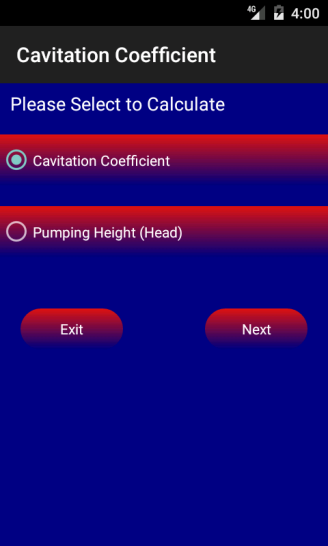
The calculator can also calculate the pump head providing that the Cavitation coefficient is defined. Input can be specified in different units of measurements as shown below:
Pressure – bar, kPa, Pa, psi, lb/ft2
Density – kg/m3, lb/ft3
Velocity – m/s, ft/s
Head Loss & Pump Head – m, ft
Gravitational acceleration – m/s2, ft/s2
Download & Purchase information
This application has two versions:
A free version that includes a banner advert and requires internet connection you can download it from the Google play store
The Second version has no adverts and doesn’t require internet connection and is available for purchase from the Google Play store using the link below
for other mobile applications please click here!
System Requirement
Android operating system